
Norway pays Northern Lights for capacity. Injection has run at 15 per cent of it.
By Milan Perazich, Energy Prospector
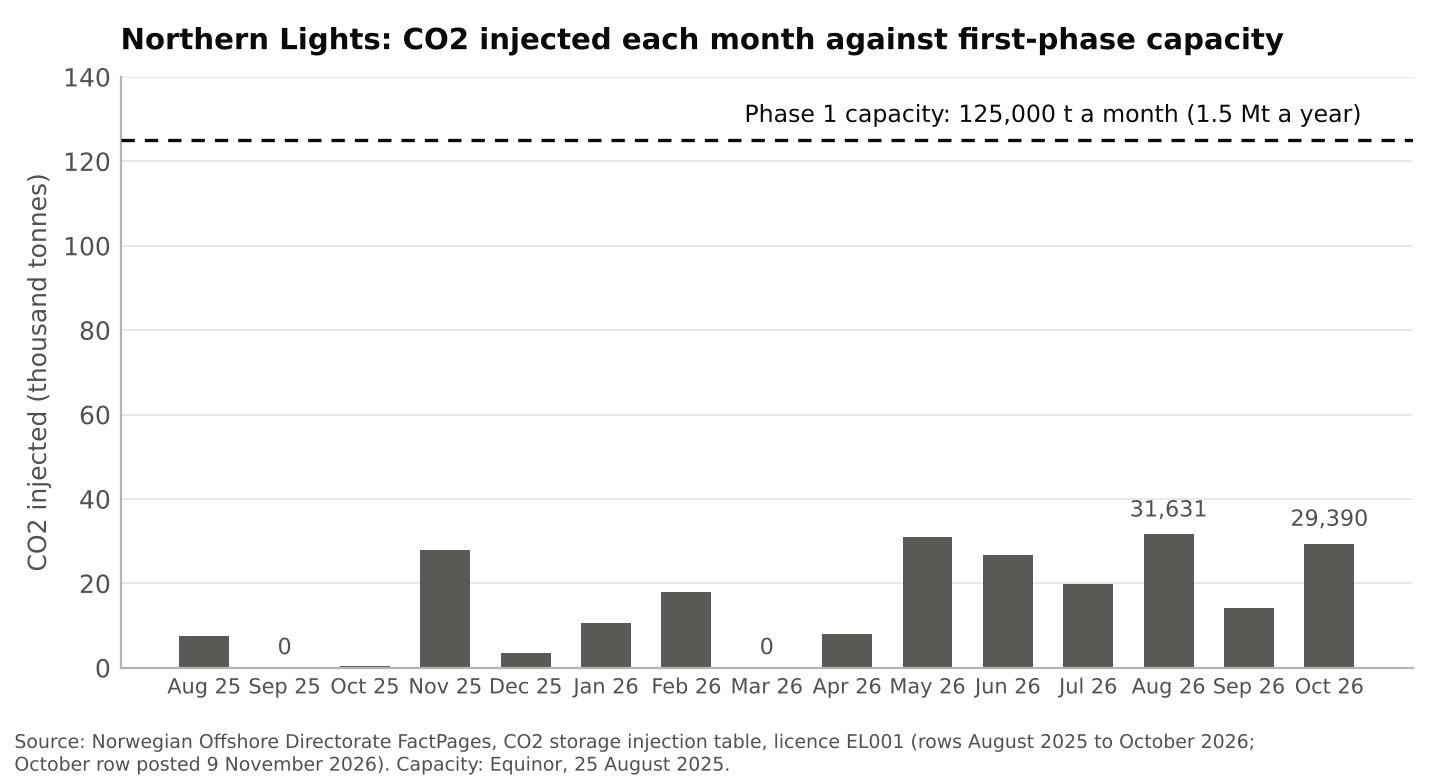
Northern Lights, the North Sea carbon storage site owned by Equinor, Shell and TotalEnergies, was built to take 1.5 million tonnes of CO2 a year. Its owners say that first phase is fully booked, and the Norwegian state covers about 80 per cent of its cost. The Norwegian Offshore Directorate's monthly injection table shows 220,638 tonnes injected in the twelve months to October 2026. That is 14.7 per cent of capacity, and the grant was written so that the shortfall would not touch the state's payment.
The grant
The state's operating grant to Northern Lights is set out in a public version of the grant agreement between the energy ministry and the joint venture. Clause 21.1 says the operating grant "er uavhengig av mengde CO2 som gjøres tilgjengelig" from the state-supported capture operators for storage: it does not depend on how much CO2 is made available. Clause 26 pays it on the company's actual eligible operating costs within the agreed capacity.
The EFTA Surveillance Authority, which approved the aid in Decision 093/20/COL on 17 July 2020, put it the same way (para. 233): operating aid "is granted based on transport and storage capacity provided by Northern Lights, regardless of the amount of CO2 available from the State-supported capture projects". The state's share of operating costs runs from 95 per cent in year one to 80 per cent in years four to ten (para. 237).
In phase one there is a single deduction tied to volume. Under clause 49.2 the grant is cut if Northern Lights does not make capacity available or cannot receive and store CO2, and only above 10,000 tonnes a year. The deduction protects the capture plants against a store that fails them; nothing in the terms responds when the capture side sends too little.
The state pays a share of the cost of keeping 1.5 million tonnes of capacity open and leaves selling that capacity to the operator. For a first-of-a-kind chain that is a defensible bargain, but it leaves the public payment unlinked to the public result.
The tonnes
The Directorate publishes one row a month for the Aurora licence, EL001. Since first injection in August 2025 the rows add to 228,723 tonnes. Two months, September 2025 and March 2026, show none. The best month, August 2026, recorded 31,631 tonnes, about a quarter of the 125,000 a month that 1.5 million a year implies. October 2026 came in at 29,390, posted on 9 November.
The bookings
On the operators' own figures, 2026 should have been busy. Heidelberg Materials says its Brevik cement plant will capture around 400,000 tonnes a year. The European Commission inaugurated Yara's Sluiskil plant on 7 September 2026, set to capture "up to 800 000 tons of CO₂ annually" for storage at Northern Lights. Ørsted's agreement is 430,000 tonnes a year from 1 January 2026. Once all three are running, that is up to 1.63 million tonnes a year, more than the first phase can take. Ten months into 2026, 189,232 tonnes have gone in, and Yara's plant was inaugurated only in September.
The table does not split tonnes by customer, so it cannot say whose CO2 is missing. Shipping schedules, the capture plants or the terminal could each explain part of it, and the operator is the one who can say which.
Why it matters now
The owners have committed NOK 7.5 billion to a second phase of at least 5 million tonnes a year, due in the second half of 2028. The ministry says that expansion is financed without state support, with EUR 131 million from the EU. Phase two is sized for demand the injection record has not yet shown.
Norway's Office of the Auditor General is examining Longship, the programme Northern Lights belongs to. The energy ministry's 2026 letter to Gassnova tells it to "Bistå departementet i Riksrevisjonens undersøkelse av Langskip": assist the ministry in the Auditor General's examination. By 23 November 2026 the Auditor General had not reported.
Norway is also the better case on disclosure: it publishes the tonnes month by month, where anyone can count them. In the United States, the EPA has moved the deadline for 2025 greenhouse gas reports, storage included, to 10 March 2027. Norway's table at least shows the gap; the American record has no 2025 figures yet.
The missing condition
In my research on North American carbon capture subsidies I call this the missing delivered-capture condition: public money is tied to building or holding capacity, and nothing in the terms recovers it when the tonnes do not arrive. Northern Lights is a storage-side version of the same design, with its operating grant paid on capacity. One difference counts in Norway's favour. The tonnes are published, so the gap can be measured from outside.
What to watch
The November row should appear in mid-December. A month of 30,000 tonnes is a run rate of 360,000 a year, still under a quarter of capacity. The questions for Northern Lights, Gassnova and the ministry are simple: which booked volumes have not arrived, when they will, and whether the state's terms change if they do not. The Auditor General's report will give the state's own auditor's answer.
Milan Perazich is principal consultant at Energy Prospector and an independent researcher on carbon capture verification and disclosure, with over two decades in upstream drilling operations. Energy Prospector's CCUS Delivery Assurance work covers the gap between announced and operating capture. ORCID 0009-0005-4480-5315.